The build decides the conversation
The same AI model can feel brilliant on one website and broken on the next.
Same brain. Same knowledge. Completely different experience. One agent answers a nervous parent in two taps. The other makes them type their postcode, their child’s age and three possible days before anything useful happens.
The difference is not the AI. It is the build.
When people search for the types of chatbots, they usually find long lists of jargon. In practice, there are three builds that matter to a business owner:
- Structured flows. The business steers. Buttons and set paths.
- Pure AI. The customer steers. They type, the agent replies in text.
- Hybrid. Both steer. The AI understands the question, then builds the buttons on the spot.
These are practical conversation designs, not rigid categories. Here, “pure AI” means a text-only setup. Hybrid can mean any mix of rules and AI; we focus on AI-generated rich responses alongside controlled steps.
To keep this simple, we will use one picture all the way through: a trip to Ikea. The arrows on the floor. The hidden shortcut. The helpful assistant you flag down when you are lost.
By the end, you will know which build fits your business, where each one quietly fails, and why hybrid is our honest default for most teams.
Build your first hybrid agent and see how customers move when the path builds itself.
Try your first month for $19.99 $19.99 for your first month, then $29/month.Why build design matters more than the model
There is a lot of debate about which model is best. OpenAI, Claude or Gemini? It is a fair question, and it matters for cost and quality. But your customers will never see it.
Nobody opening your Instagram DMs thinks, “Ah, a lovely large language model.” They think, “That was quick,” or “Why is this so hard?”
Customers do not feel the model. They feel the design.
Build design decides three things:
- Who steers. Does the business lead the customer down a path, does the customer lead with their own words, or do they share the wheel?
- How fast customers reach an answer. Tapping a button takes a second. Typing a full sentence on a phone takes much longer, and some people simply give up.
- How often things go wrong. A fixed path rarely goes off the rails, but it cannot cope with surprises. Open conversation copes with surprises, but it can wander.
Think of it as a line. At one end, the business holds the map. At the other, the customer roams freely. Every build sits somewhere along it.
Once you see your agent as a decision about steering, most of the other choices become easier. Let’s walk the shop floor.
Structured flows: the Ikea route
You walk into Ikea. Before you have even found a trolley, there are arrows on the floor. Living rooms first. Then kitchens. Then bedrooms. Then the marketplace with candles you did not plan to buy. Then the warehouse. Then the tills.
There are shortcuts. Little doors between sections that cut half an hour off your visit. But they are not signposted loudly. You have to know they exist, or spot them by luck.
That is a structured flow.
The business controls what the customer sees, and when
In a structured flow, you decide every step. The welcome message. The three options on the first screen. The question that follows each tap. What appears at the end.
Nothing surprises you, because you wrote all of it. That is reassuring for owners, and it makes the agent easy to check. If someone says the bot told them something odd, you can open the flow and see exactly which box said it.
Who loves it, and who hates it
Some customers love being walked through. They are not sure what they need. They want someone to say, “Start here, then here, then you’re done.” For them, a flow feels calm and guided. Three taps and they have a trial booked.
Other customers arrive knowing exactly what they want. They have a specific question: “Do you have parking?” or “Is the Saturday class suitable for a child who hates getting their face wet?” For them, the arrows are a maze. The button they need is not there, so they hunt for the shortcut, tap Back four times, or close the chat.
Same as Ikea. Lovely when you are browsing for ideas on a Sunday. Maddening when you only came in for a lamp.
Why conversion can be very high
It is easy to sneer at the Ikea route. But Ikea does not do it by accident. The path is deliberate. It shows you things in an order that makes sense, keeps you moving, and ends at the till.
A good flow works the same way. It removes decisions. It asks one simple question at a time. It points every path towards one action. For a business with one clear goal, that focus can work very well.
We will not quote you a magic conversion number, because it depends on your offer, your traffic and your audience. But do not dismiss structured flows as old-fashioned. When the job is narrow, they are often sharp.
How it works under the hood
Mostly if/then logic. If the customer taps Book a trial, ask their child’s age. If they pick 3 to 5, show the matching classes. If they pick Just looking, offer a price list and a friendly exit.
The building blocks are buttons, quick replies, simple questions and saved answers. You draw it once in a visual builder, test each branch, and it behaves the same way every time.
AI still has a place
A structured flow does not have to be AI-free. Think of the sales assistant standing in the bedroom section. You can follow the arrows all day, but at any point you can wave them over and ask a question.
In a flow, that might be a button labelled Ask a question. Tap it, and the AI steps in to answer something the path did not cover. Then it can hand the customer back to the route, or pass them to a person.
That is a big improvement on a flow that simply says, “Sorry, I didn’t understand. Please choose an option.”
Best for
- Bookings with a few fixed choices.
- Trial or class sign-ups.
- Lead qualification with a short list of questions.
- Campaign replies, such as a comment-to-DM offer.
- Anything with one clear end point and a predictable customer.
If most of your customers want the same thing, draw them a good path. Just make sure the shortcut is visible.
Pure AI: the open-plan shop
Now picture a different shop. No arrows. No set route. Just one big open room, and a very knowledgeable assistant who will answer anything you ask.
That is pure AI. The customer types whatever is on their mind, and the agent replies in text, using your knowledge base and instructions.
The strengths are real
It handles the long tail. Customers ask wonderfully specific things. “Can my son wear goggles?” “Do you have a female instructor?” “Is the pool warm enough for a baby who feels the cold?” You would never build a button for each of those. A well-briefed AI can answer them all.
It feels natural. People can talk the way they talk. Typos, half-sentences and three questions in one message are all fine.
There is no flow to map. You write a clear prompt, add your approved information, set rules and test. You are not drawing hundreds of branches for every possible question.
The weak spots are real too
Typing is slower than tapping. On a phone, every next step becomes a small chore. Where are you based? What day suits you? Morning or afternoon? Each answer means opening the keyboard again. Some customers will do it. Plenty will drift off.
No tracks means it can derail. An open conversation can wander. A customer asks about a birthday party, then a refund, then the weather. Without clear scope and rules, the agent may follow them all the way, and lose sight of the booking.
Text only can feel dull and robotic. A wall of polite paragraphs is not much of a shop. There is nothing to tap, nothing to look at, and no obvious next step. Even a helpful answer can feel like reading terms and conditions.
In our open-plan shop, the assistant is clever, but there is no signage, no displays and no till in sight. You get great answers and still leave without buying the lamp.
What it takes to do well
Pure AI is not “switch it on and walk away.” To work well it needs:
- Tight prompts. Clear instructions on tone, length, what to answer and what to avoid.
- Clear scope. What the agent covers, and what it politely declines.
- Approved information. Prices, opening hours and live availability must come from your approved data or connected systems. The AI should never guess them.
- Safeguards. Rules on claims, refunds and sensitive topics, plus a route to a real person when needed.
Best for
Support and FAQs, where questions are wide and hard to predict. Think “How do I reschedule?”, “What should my child bring?” and “Can I pause my membership?” When the customer’s job is to get an answer rather than complete one action, the open-plan shop works nicely.
Hybrid: the sales assistant who builds the path for you
Now imagine the best version of the shop.
You walk in and tell an assistant what you are after. They listen, answer your actual question, and then lay out a short path just for you: three options, clearly labelled, right in front of you. You tap one and you are nearly at the till.
That is hybrid. The customer steers with their own words. The agent replies, then offers the next steps as buttons, quick replies or image cards, created on the fly.
How it works in ChitChatBot.ai
With ChitChatBot.ai, the AI can generate rich messages straight from your prompt. That means buttons, quick replies, images and carousels, created in the moment to fit what the customer just asked. You do not have to pre-build every path. You describe how the agent should respond, and it builds the right next step for each conversation.
It is not website-only. Rich responses work across supported channels, including webchat and social messaging, and ChitChatBot adapts each message to the channel. The same agent can also take configured actions while it replies, such as adding a tag, saving a field, starting a flow or handing over to a person. Our rich responses guide explains the setup.
One question, three builds
Let’s make it concrete. A parent messages a swim school:
“do you do lessons for a nervous 4 year old?”
Here is how each build handles it. The swim school, class names and times below are fictional.
Fast and tidy. But the real worry is never heard.
Warm and accurate. But every next step is a chore.
Heard and guided. The worry is answered, the next step is a tap.
Look at what changes. The structured flow is quick, but it never hears the most important word in the message: nervous. That is the thing the parent actually cares about. The pure AI answer is kind and correct, but then the parent has to type, type and type again.
The hybrid agent does both. It answers the worry in plain words first. It checks location before showing times, because class times only make sense for the right pool. Then it lays out the next step as cards and quick replies, with a graceful exit for anyone not ready yet.
In a real build, those class cards would come from your connected booking system or approved timetable. The AI arranges them, but it does not invent them. And a booking is only confirmed after your configured booking action succeeds. If that is not connected, the agent saves the parent’s preferred slot for your team to confirm.
It works on social channels too
Hybrid is not just a website trick. Here is an existing example from Instagram, where a written answer sits alongside clear next-step buttons.
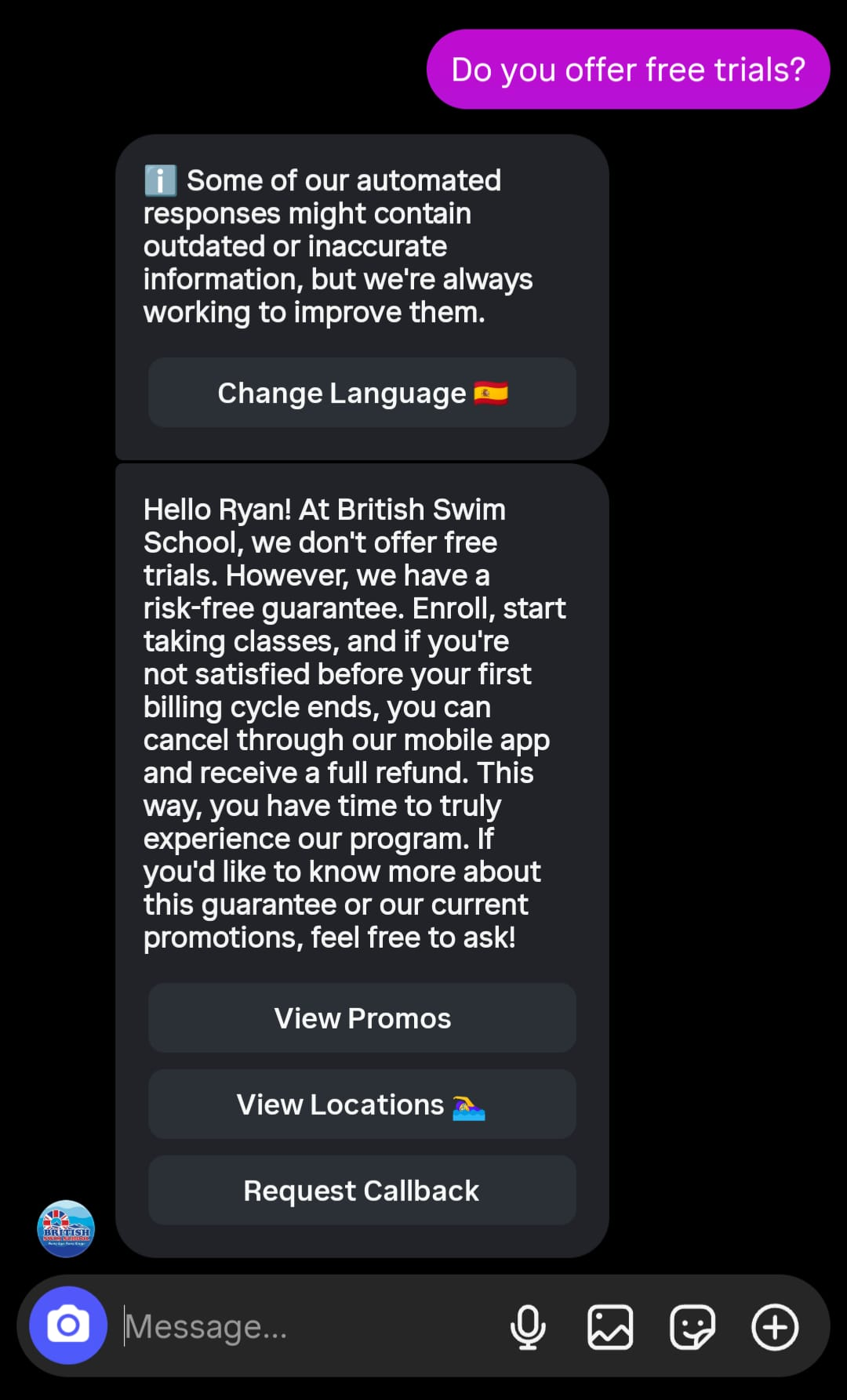
A note on channels. Each one has its own rules about what can be shown. Instagram, Messenger and webchat support different mixes of buttons, quick replies and cards. WhatsApp has its own formats, such as reply buttons and lists, and it does not display every rich layout the way webchat does. ChitChatBot adapts messages to each channel, but some message types are not supported everywhere. A good hybrid prompt plans for that, with a list or a short text option when a carousel will not fit. See our pages on web chat, Instagram, Messenger and WhatsApp for more.
Why hybrid beats both
Back in the shop: the structured flow is the arrows on the floor, and pure AI is the assistant in an empty room. Hybrid is the assistant who listens to you, then walks you straight to the right shelf.
You get the freedom of AI, because customers can ask anything in their own words. You also get the speed and guidance of a flow, because the next step is a tap rather than a paragraph.
Customers who like being guided get a path. Customers who know what they want get a shortcut. Nobody has to hunt for the hidden door.
Flows steer. AI listens. Hybrid does both.
Hybrid is not magic
This matters, so we will say it plainly. Hybrid is the strongest default, but it still needs work:
- Scope limits. Tell the agent what it covers and what it should hand on.
- Human handover. A clear Talk to a person route, especially for upset or complicated customers.
- Rules on prices and claims. Prices, offers and availability come only from approved data or connected systems. No guessing, no promises you cannot keep.
- Honest confirmations. Only say “booked” when the booking action succeeded.
- Testing before launch. Try awkward questions, typos, angry messages and off-topic chats before real customers do.
- Channel limits. Plan for the buttons and card formats each channel actually supports.
A sharp prompt and a few safeguards turn hybrid from clever into dependable.
Side by side
Here is the whole shop floor in one view.
| Factor | Structured flow | Pure AI | Hybrid |
|---|---|---|---|
| Who steers | The business | The customer | Both |
| Speed for the customer | Fast taps, if their need is on the path | Slower, every step is typed | Fast, typed question then taps |
| Flexibility | Low, only what you mapped | High, any question | High, with guided next steps |
| Build effort | Mapping every branch | Prompts, knowledge and rules | Prompts, rules, rich-response setup and testing |
| Risk of derailing | Low | Higher without tight scope | Moderate, reduced by scope and safeguards |
| How it feels | Guided, sometimes rigid | Natural, sometimes dull | Natural and quick |
| Best for | Bookings, sign-ups, one clear goal | Support and wide FAQs | Most businesses mixing questions and actions |
Read across any row and the pattern is the same. Structured flows trade flexibility for control. Pure AI trades speed for freedom. Hybrid tries to keep the best of both, and pays for it in setup and testing time.
That last point is not small print. If you choose hybrid, budget the time to write and test prompts properly. The table rewards the teams that do.
When each one is the wrong choice
Every build has a day when it is the wrong tool. Knowing that day is half the decision.
Structured flows are wrong when customers arrive with specific, varied questions. If your inbox is full of “Can I…?”, “Do you…?” and “What if…?”, a fixed path will keep missing the point. It is Ikea when you only wanted a lamp: lots of walking, little help. Customers will tap through, fail to find their question, and leave.
Pure AI is wrong when you need customers to complete one action fast. If the whole point is “book a trial” or “claim this offer”, a text-only conversation adds friction at every step. Asking someone to type a day, a time and an email on a phone, one message at a time, is the open-plan shop with no till. Lovely chat, no sale.
Hybrid is wrong when you cannot commit time to writing and testing prompts. It is flexible because it is guided by instructions, and weak instructions give weak results. If nobody on your team can own the prompt, review conversations and tweak rules, start with a simpler flow.
Hybrid is also wrong when a regulated script must be followed word for word. Some industries need exact wording, every time, with no variation. In those moments, a structured flow is the safer choice. You can still use AI elsewhere, such as general questions, but keep the scripted part fixed.
There is no shame in picking the simpler build. The worst choice is the one that does not match how your customers actually behave.
How to choose: four questions
Grab a coffee and answer these honestly. They will point you to the right build faster than any feature list.
1. How predictable are your customers’ questions? If nine out of ten people ask the same three things, a structured flow handles it well. If questions are all over the place, you need AI listening.
2. Do you need to steer customers to one action? If there is a clear finish line, such as a booking, a trial or a callback, you want guidance and buttons. Pure AI on its own struggles here. Structured or hybrid will serve you better.
3. Which channels do your customers live on? Webchat, Instagram, Messenger and WhatsApp all show buttons and cards a little differently. Choose a build and a prompt that plan for those limits, so every customer gets a clear next step.
4. Who will own and test the prompts? Hybrid and pure AI need an owner. Someone who reads conversations, fixes gaps and keeps prices and claims accurate. If you have that person, hybrid is the strongest default. If not, start structured and grow.
Common questions about types of chatbots
What are the main types of chatbots?
For most businesses there are three: structured flows that guide customers with set buttons and paths, pure AI agents that answer typed questions in text, and hybrid agents that understand free text and then offer buttons, quick replies or cards as the next step.
Is a rule-based or AI chatbot better?
It depends on the job. A rule-based, structured flow is great when customers want the same thing and you need one clear action. An AI chatbot is better for wide, unpredictable questions. For most businesses that get both, a hybrid build is the strongest default.
What is a hybrid chatbot?
A hybrid chatbot lets customers ask anything in their own words, then responds with an answer plus rich next steps such as buttons, quick replies or image carousels. In ChitChatBot.ai, these can be generated from the prompt itself, adapted for each supported channel.
Can an AI chatbot send buttons on WhatsApp?
Yes, within WhatsApp’s own formats. WhatsApp supports interactive messages such as reply buttons and lists, but it does not display every rich layout the way webchat does. A good agent plans for those limits and uses a list or short text option when a carousel will not fit.
Follow the arrows, or ask for help
Think back to that shop. The best version is not the one with the strictest arrows, or the one with no signs at all. It is the shop where you can follow the path when you want to, and flag down someone helpful when you do not.
That is what a hybrid agent gives your customers. The nervous parent gets their worry answered. The busy parent gets a time to tap. And your team gets a clearer picture of who is ready to book.
Start with one channel and one common question. Write a tight prompt, set your rules, test it, and watch how customers move. Need a head start? Browse our templates for ready-made starting points, or grab the free AI Agents for Local Service Businesses playbook for industry-specific sample conversations.