The most valuable data a brand can collect isn’t transaction data or web analytics. It’s zero-party data — information that customers voluntarily share about their preferences, goals, and needs. Zero-party data is consent-native, accurate (people tell you what they actually want), and impossible to buy from a third party.
The problem: most zero-party data collection is done via web forms, and web forms convert at roughly 2–4%. The same data collected through a conversational quiz on Messenger or Instagram DMs converts at 10–20% — and the people who complete it are significantly more engaged than form-fillers.
That gap is the business case for quiz automation.
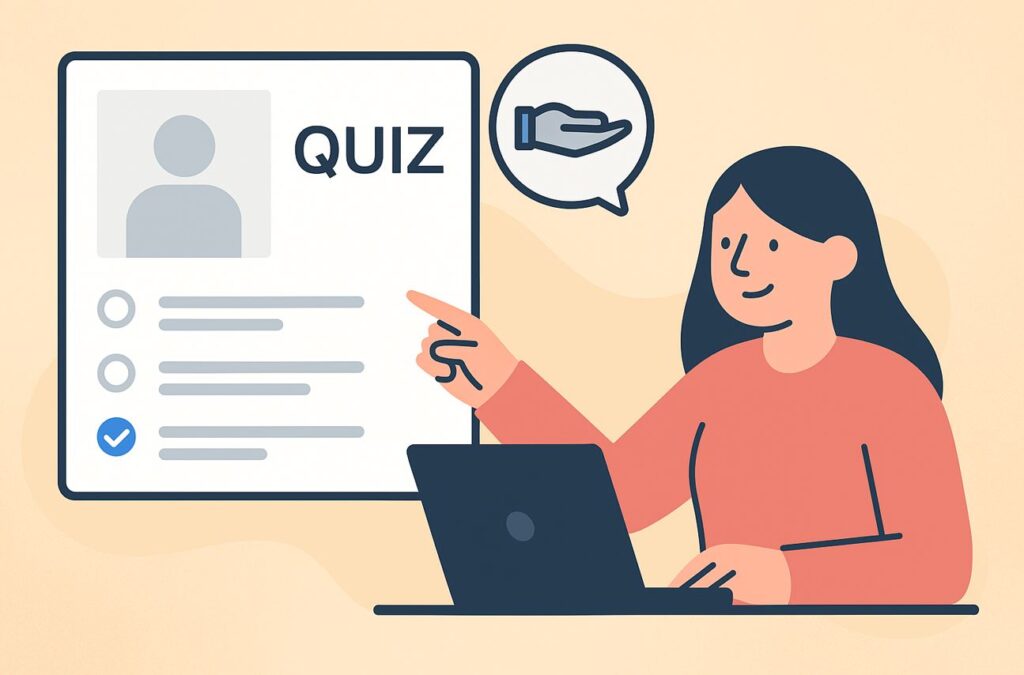
Why Quizzes Work So Well on Messenger and Instagram
Three structural reasons quizzes outperform web forms in conversational channels:
The format matches the medium. Messenger and Instagram DMs are conversational by design — back-and-forth exchanges are what users expect. A quiz that asks one question at a time, receives a tap-to-answer response, and immediately acknowledges each answer feels native to the channel. A static web form feels like an interruption in the same context.
The investment is gradual. A web form asks for everything upfront — name, email, phone, budget, timeline — before the user has received any value. A quiz starts with a low-stakes question (“What’s your biggest challenge with X?”), delivers some value after the first answer, and earns the right to ask for contact details by the final question. Completion rates follow accordingly.
Results personalisation is immediate. The expectation when completing a quiz — a personality type, a product recommendation, a diagnosis — creates intrinsic motivation to finish. A well-designed quiz delivers a genuinely useful result; the contact data is the trade-off the user willingly makes.
Engagement data is automatic. Every tap is logged. You learn not just that someone completed the quiz, but which answer they gave to each question. A restaurant brand learns dietary preferences. A fitness brand learns training goals. A travel brand learns destination interests. This segmentation data improves every subsequent campaign.
How Quizzes Help Grow Your Messenger Subscriber List
When a user engages with a quiz in Messenger or Instagram DMs, they opt in to receive future messages from your brand as part of the interaction. This is a compliant, low-friction way to grow a messaging subscriber list.
Unlike a passive post or a follow button tap, a quiz engagement is active — the user has invested time and attention. The subscriber that comes out of a quiz completion is measurably more engaged than one acquired through a standard “subscribe for updates” prompt.
For brands with existing email lists, quiz results can be used to re-engage dormant contacts through Messenger — “we built a quiz based on your interests, here’s your personalised result” consistently generates higher reactivation rates than generic email re-engagement campaigns.
Launching Your Quiz: Click-to-Messenger Ad Campaigns
The fastest way to drive quiz completions at scale is a Click-to-Messenger or Click-to-Instagram-DM ad. The ad creative sets up the quiz premise — “Find out which [product/service] is right for you in 60 seconds” — and the ad click opens the quiz conversation directly.
Click-to-Messenger ads for quiz funnels typically outperform lead form ads on:
- Cost per lead: lower, because the conversational format converts better than a form
- Lead quality: higher, because quiz completers have invested more intent
- Data richness: significantly higher, because each answer is structured segmentation data
The quiz completion acts as a natural qualifier. Someone who answers all seven questions about their [fitness goals / travel preferences / skin concerns / budget range] is a significantly warmer lead than someone who filled in a name and email on a landing page.
Building the Quiz Experience
A well-constructed Messenger quiz follows a specific structure:
Opening question: Low-stakes, easy to answer, immediately tells the user what they’ll get. “Let’s find your perfect [result]. First question — what’s your primary goal?” with 3–4 tap-to-answer options.
Middle questions (2–5 questions): Each question builds on the previous answer. Conditional logic means the user sees the most relevant follow-up — someone who said their goal is X gets asked about obstacles to X, not about goals they’ve already ruled out. This personalisation improves completion rates because every question feels relevant.
Penultimate question: The highest-value data question — the one that most directly informs the result and your segmentation. Budget, timeline, location, or whatever most determines the right next step for your business.
Final ask: Email or phone number in exchange for the result. “Last question — where should I send your personalised [result]?” By this point, completion is highly likely: the user has already answered six questions and is invested in the result.
Result delivery: Immediate, personalised, and genuinely useful. The result should feel like it was worth the quiz — not a generic “you scored 7/10, here’s our website.” A specific recommendation, a curated resource, or a tailored offer based on their answers.
Collecting Data and Seamless CRM Integration
Every quiz response can be passed to your CRM automatically. Contact record created, answers appended as custom fields, lead score assigned based on response profile, and the appropriate follow-up sequence triggered — all without manual work.
For e-commerce: quiz answers can trigger product recommendations, abandoned cart sequences, or loyalty programme invitations based on what the answers reveal about preferences.
For service businesses: quiz answers can pre-populate CRM records before the first sales conversation, so the first human contact already knows what the prospect needs rather than starting from scratch.
For media and content brands: quiz completion segments contacts into interest clusters that inform editorial personalisation and advertising targeting.
Analysing Results and Segmenting Your Audience
The data from a running quiz improves over time. After 500 completions, you know the most common answer profiles — and you can build campaigns specifically for each segment.
A fitness brand running a goal-setting quiz might discover that 40% of completers identify “staying consistent” as their primary challenge. That’s a content and product brief: build the next three months of content around consistency frameworks, and offer the product most relevant to that audience in the follow-up sequence.
Segmentation like this is impossible to buy from a data provider and extremely expensive to collect any other way. The quiz generates it as a by-product of the lead generation activity.
Messenger Quiz vs. Traditional Website Form
| Messenger Quiz | Website Form | |
|---|---|---|
| Average completion rate | 15–25% | 2–5% |
| Data richness | High (multiple structured answers) | Low (name, email) |
| Segmentation depth | Automatic from quiz answers | Minimal |
| Experience for user | Conversational, personalised | Static, impersonal |
| Subscriber opt-in | Built-in | Separate step |
| CRM sync | Automatic | Usually requires integration |
The completion rate gap alone justifies the quiz format for most brands. The additional segmentation data is the multiplier.
Let’s Build Your First Messenger Quiz
The starting point doesn’t need to be complex. A five-question quiz with three answer options per question, delivering one of three personalised results, is enough to validate the format for your audience. Build the simple version first, measure completion rate and lead quality against your existing acquisition methods, then expand.
Brands that have done this consistently report two findings:
- Quiz leads convert to customers at higher rates than other digital lead sources
- The quiz data improves campaign ROI across every subsequent channel because segmentation is richer
If you want the quiz built, integrated with your CRM, and paired with a Click-to-Messenger ad campaign — our DFY service handles the end-to-end. Most quiz funnels are live within two to three weeks.
If you’d rather explore the platform first, the DIY option gives you the flow builder to construct and test it yourself.
The data your customers willingly share is more valuable than anything you can infer from behavioural tracking. A quiz is the most effective mechanism for collecting it.